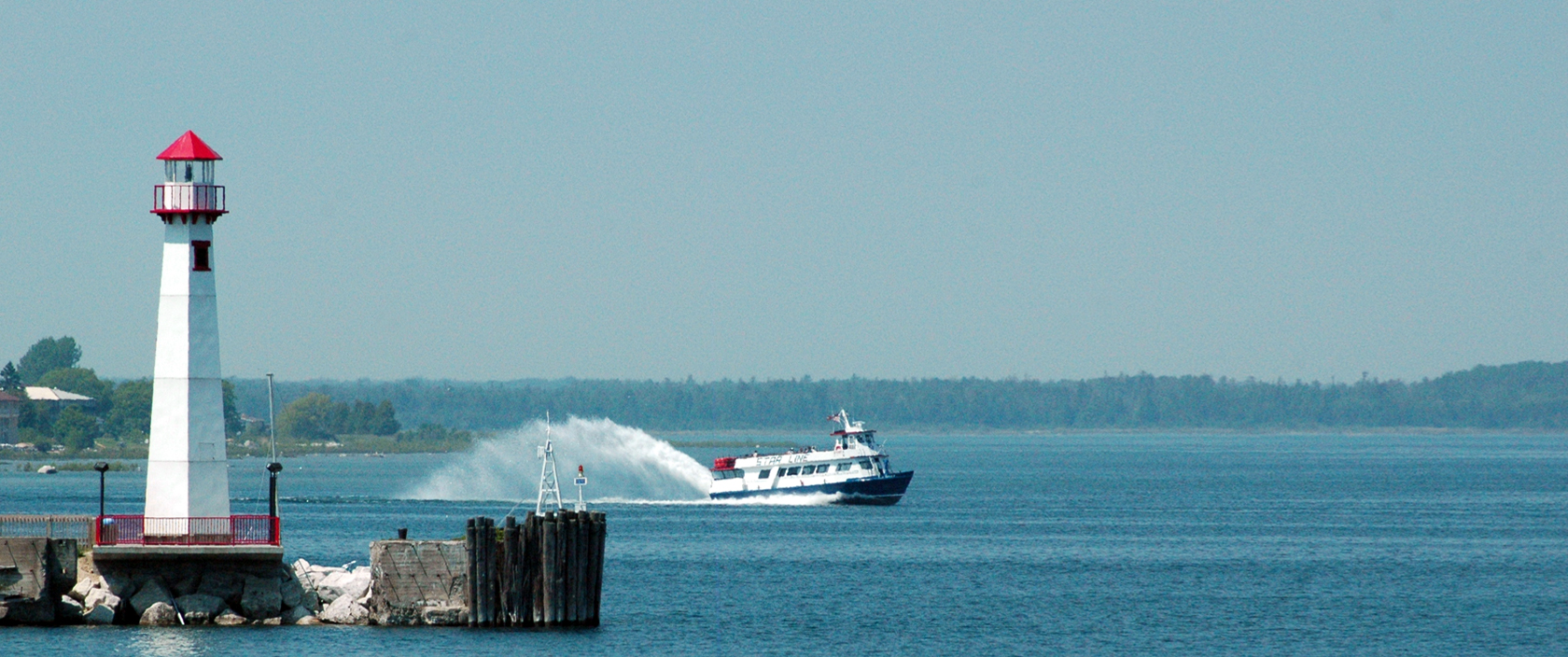
An alternative to taking the bus is to take a ferry to Mackinac Island, and then to St. Ignace. Although not directly on the route of the NCT, this island park provides an interesting side trip. Reached by ferry from Mackinac City or St. Ignace, bicycles, your own feet, or horses are the only modes of transportation on the island; motor vehicles are not allowed. Mackinac Island was designated as our second national park in 1875, a status it retained until 1895 when the park was turned over to the state. No camping facilities are available on the island, but many resort hotels and tourist rooms are located in the village. Bring money.
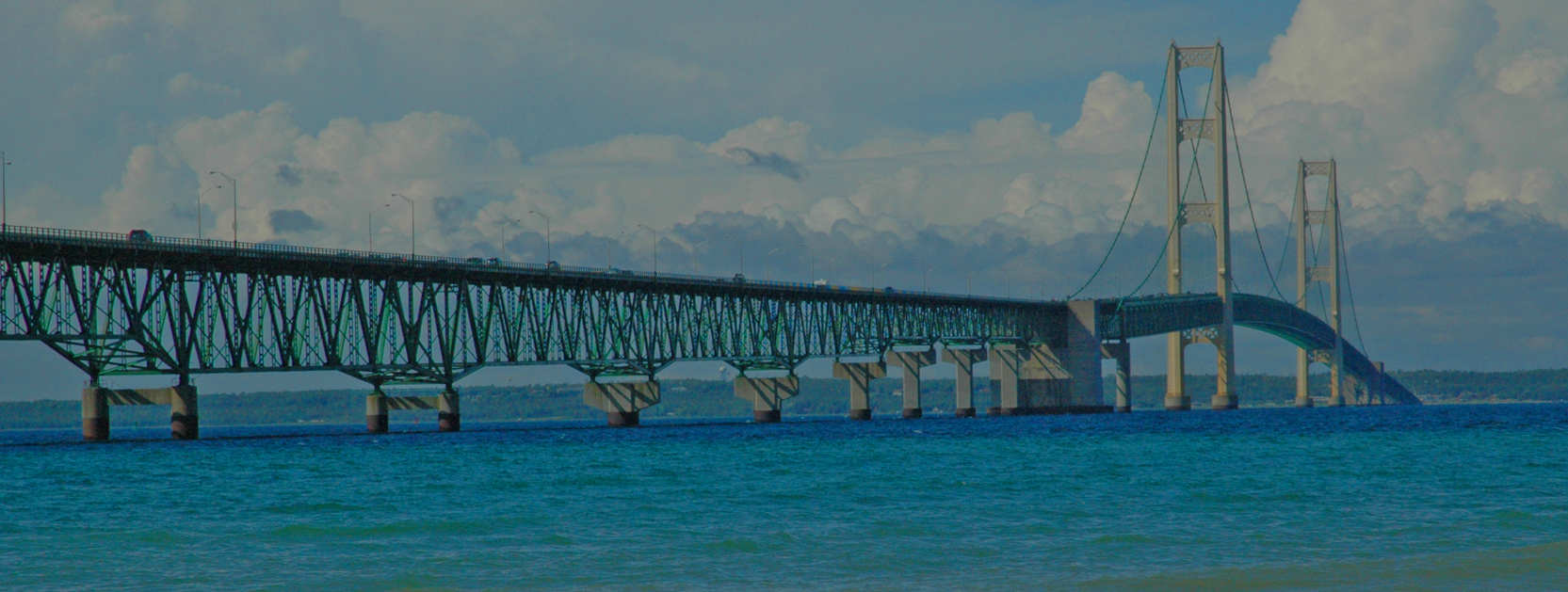
Just north of Big Mac, a long section of completed NCT begins. Though this is the shortest of the "big three", it has far and away the highest percentage of certified trail, and is the one of the trail's longest consistently wild sections. Supplies are only available at rare locations over the next 210 miles. As this long segment falls in the responsibility of several agencies, information must be sought in several locations. At this writing, trailhead for the first segment in the Hiawatha National Forest, St. Ignace Ranger District, is located on Castle Rock Road (FR3104), about four miles north of St. Ignace, but the user can follow an uncertifiable abandoned railroad grade turned snowmobile trail north from the outskirts of St. Ignace to the intersection with the trail. The NCT in the St. Ignace Ranger District winds north for 36.5 miles, all on forest land. The trail has been criticized in the past for not being well marked or cleared, but recent Forest Service work has markedly improved the situation, including the development of several boardwalks elevated over wetlands. One developed and one primitive campground are located along the trail in this district, but camping is allowed alongside the trail. For information, contact Hiawatha National Forest, St. Ignace Ranger District, 1498 W. US-2, St. Ignace, MI 49781, (906) 643-7900; or Hiawatha National Forest, Sault Ste Marie Ranger District, 4000 I-75 Business Spur, Sault Ste. Marie, MI, 49873 (906) 635- 5311. "Certified Sections of the North Country Trail - the NCT in Upper Michigan" has a segment on the Hiawatha, available from the NCTA Trail Store for $9.50. The segment is also covered in the Michigan "F" Mapsets, available from the Trail store for $4.00. Bordered by Lake Superior to the north and by Lake Michigan and Lake Huron to the south, almost half of the Hiawatha's 880,797 acres are wetlands, with 413 inland lakes and over 775 miles of streams. Along the path, stands of northern white cedar, aspen, pine and northern hardwoods are found. The trail passes near many sites of historical interest; archaeological remains of ancient Indian settlements are sometimes found along the shores of lakes and rivers. Subtle traces of old logging camps and pioneer homesteads are often located in grassy openings in the forest or along abandoned roads or railroad grades. As the trail crosses the county line into Chippewa County, it enters the Sault Ste. Marie Ranger District. This has 42 miles of certified trails north to Lake Superior. There are two developed campgrounds and several bivouac areas. Trailside camping is permitted. For more information, contact Hiawatha National Forest, Sault Ste. Marie Ranger District, at the above address. Emerging from the Hiawatha National Forest on Tahquamenon Bay, the trail follows new trail through state land for about 5 miles until reaching Rivermouth Campground in Tahquamenon State Park. This trail segment in Tahquamenon more or less parallels the Tahquamenon River for 17 miles through the park. Camping is only permitted in the two developed campgrounds unless prior arrangements have been made. The 21,000 acre park contains outstanding scenery, including the second largest waterfall in the east. Contact Manager, Tahquamenon Falls State Park, Paradise, MI 49768, or DNR. From the boundary of Tahquamenon Falls State Park, the trail goes west in Lake Superior State Forest, then north, then west along the shore of Lake Superior 44 miles to Grand Marais through Lake Superior Forest and Muskallonge Lake State Park. There are six state forest campgrounds and the state park campground along the route, and trailside camping is permitted. The trail is marked with the NCT marker and blue paint blazes; trail maintenance was reportedly poor for some time, but has recently undergone a major overhaul. Again, the best information on this segment is in "Certified Sections of the North Country Trail - the NCT in Upper Michigan". The segment is also covered in the Michigan "F" Mapsets, available from the Trail store for $4.00. The 26 miles of NCT along the shore of Lake Superior from the mouth of the Big Two-Hearted River to Grand Marais would be considered pretty scenic trail anywhere, but they rather pale when compared to the next segment, the 43 miles of North Country Trail in the Pictured Rocks National Lakeshore, the only major segment of National Park Service land on the entire NCT. The NCT here, formerly knowan as the "Lakeshore Trail" is marked with the NCT marker or a variant, and routed wooden signs at all trail heads and intersections. Hiker's fingers will grow weary depressing the shutter buttons of their cameras as they try to capture the outstanding scenery of the Lake Superior shoreline - the massive Grand Sable Dunes, beautiful sandy beaches, and the magnificent Pictured Rocks. Historic sites such as the log slide and Au Sable Point Lighthouse will intrigue hikers. Two developed and 12 backcountry campsites are located along the trail. A free permit is required to camp overnight in the back country. Permits can be obtained at the park headquarters or at the visitor centers at either end of the trail, in Grand Marais and Munising. This is probably the most heavily-used regular segment of the NCT in Michigan. End-to-end walking of the National Lakeshore is sufficient that the Park Service, in cooperation with Alger County, runs a shuttle bus in summer months between the two vis itor centers to return hikers to the trail head. For information on this, plus brochures on the park, the Lakeshore Trail, and backcountry camping, contact Superintendent, Pictured Rocks National Lakeshore, PO Box 40, Munising MI 49862. The North Country Trail Store also stocks the invaluable "Guide to the Pictured Rocks National Lakeshore", by Olive Anderson, available for $6.95. Again, "Certified Sections of the North Country Trail - the NCT in Upper Michigan" and the Michigan "F" Mapsets provide valuable information. This stellar segment of the NCT ends with a segment in the Hiawatha National Forest west of Munising. The marked trail follows roads for about four miles through the city, then goes off-road for about 15 miles at a trailhead off M-94. The trail was certified to the junction of Rock River Road and FR2276 in 1989. Five "dispersed campsites" have been recognized, but other campsites and bivouac areas are yet to be developed. Trailside camping is permitted on all but the few sections of private land the trail crosses. A separate US Forest Service map is available for this segment. For further information, contact Hiawatha National Forest, Munising Ranger District, 400 Munising St., Munising MI 49862. Trail is under intensive development from Rock River Road far to the west at Covington, where the Ottawa National Forest picks up. From Rock River Road to Marquette, the "F" Mapsets are the guide of choice; from there to Covington, the "G" mapsets. A connection, involving low-use forest roads and new trail, connects to Laughing Whitefish Falls to the west, but the North Country Trail Hikers Club of Marquette, Michigan, an NCTA Chapter, is still working on the segment and it isn't all the way ready for certification yet. Good county maps are highly recommended in this area, as it will sometimes involve following roundabout forest roads to get from segment to segment. From Rock River Road, it's about 30 miles, sometimes on road, sometimes off, partly through the highly scenic Laughing Whitefish Falls area, until reaching the village of Harvey on the outskirts of Marquette. From Harvey, a six-mile usable bike path follows the shore through Marquette to Presque Isle City Park, north of town. The general route of the NCT extends through north-central Marquette County. For several years, the NCTA, Sierra Club and the North Country Trail Hikers Club have been working on connecting the Hiawatha and Ottawa National Forests on largely private lands. Segments of the trail have been completed in and near Craig Lake State Park and the McCormick Wilderness Area of Ottawa National Forest, and elsewhere, but all the trail yet completed is not yet usable, as some completed segments are one-ended; a usable segment of 30 miles or so in the vicinity of the McCormick Tract and Craig Lake State Park is completed and usable, although out of the way for the through-hiker. If you'd like to help out, an annual work session is held in August. Contact North Country Trail Hikers Club, 12 Middle Island Point, Marquette, MI 49855 for more information. It's possible for the long-distance hiker to follow roads through western Marquette and Baraga Counties to get from Presque Isle City Park to the next usable segment, near Craig Lake State Park, and on to the Ottawa National Forest, but if a user wants to stay close to the planned route of the trail by using forest roads, this is one area where topographic maps are not a bad idea. Virtually all land in this area, with the exception of Craig Lake State Park and the McCormick tract are privately held. For information on the trail in Marquette and Baraga Counties, contact the North Country Trail Hikers Club at their Marquette address, given above; for Craig Lake State Park, contact DNR; on the McCormick tract, contact Forest Supervisor, Ottawa National Forest, East US2, Ironwood, MI 49938. The segment is covered in the Michigan "F" Mapsets available for $5.00 from the North Country Trail Store. At the western end of this segment, the Tibbets Falls segment was completed in 1988, and connects with the NCT in the Ottawa National Forest. The trailhead, in central Baraga County, is at the dead-end of Autio Road at Nestor Creek, 2 1/2 miles west of US 41. This 5.8 mile segment is located entirely on private land and no camping is permitted. However, it's expected that the segment south of the Sturgeon River will have to be abandoned soon due to clear-cutting; local activists are working on a route to the north of the river, which will include the scenic Sturgeon River Gorge. The Tibbets Falls segment comes to an end at the trailhead for the NCT in the Ottawa National Forest, in western Baraga County. Pine, hemlock, sugar maple and yellow birch once characterized western Michigan's upper peninsula forests. Logging in the late 1800s and early 1900s, followed by wildfires, drastically changed the mixture of forest trees. Aspen, paper birch, and balsam fir grew back in cut-over areas. About 106 miles of North Country Trail wanders through landscapes rich in history, wild life, and natural beauty. The trail in the Ottawa National forest is one of the standout jewels of wilderness along the NCT. In the easternmost reaches, it passes near the Sturgeon River Gorge wilderness; outlooks on the eastern rim of the gorge offer stunning panoramas, especially during fall color season. Volcanic rock outcrops form the 20 foot high Sturgeon Falls. Most of the trail in the eastern half of the Ottawa National Forest is wild and primitive. Trailside camping is permitted, and the trail passes one developed campground. Completed portions are blazed in blue. For information on this and other Ottawa National Forest segments, contact the Ottawa National Forest, 2100 East Cloverland Drive, Ironwood MI 49938. (906) 932-1330 or, for Michigan residents only, (800) 562-1201. "Certified Segments of the North Country Trail," by Byron and Margaret Hutchins, also has a segment on the Ottawa National Forest including Porcupine Mountains Wilderness State Park, available from the North Country Trail Store for $4.00. The western half of the Ottawa, from US45 on west, is among the most scenic and rugged sections of the NCT in Michigan. The trail crosses the Ontanagon River below the Victoria Dam; when the dam isn't releasing, it's a rock-hop, but at times of high water, it's impassible, and hikers must detour on US45 and local roads through Rockland. New trail was recently completed through Old Victoria Historic Village, a couple miles west of the dam, and on-road segments between there and Norwich have recently been replaced with new trail.. At Norwitch, hikers may examine remains of the old Norwich Mine in evidence along the trail; west of Norwich, the trail picks up again on the 28 mile Trap Falls segment, which is about as rugged as the NCT gets in Michigan. Get local information before starting out on this segment, especially in times of high water; a bridge over a branch of the Ontonagon River recently collapsed under snow load, and it may be some years before it will be replaced; the stream is dangerous to wade in high water. This segment comes to an end at the boundary of the Porcupine Mountains State Park. There are a couple of places that are hard going, especially on the Trap Falls segment, reputedly the ruggedest segment of the whole NCT. The Porcupine Mountains have many miles of some of the finest trails in the midwest. The route the NCT takes is regarded by some as the park's wildest part, but not its most scenic. A little map work will give hikers more scenic routes, including one along the Lake Superior shoreline, if they wish to go a longer distance. This 58,000 acre park is one of the few remaining large wilderness areas in the midwest. Towering stands of virgin timber, four secluded lakes, and miles of wild rivers and stre ams await hikers who venture there. Bear sightings are not uncommon. The park contains 85 miles of backpacking trails which lead hikers to spectacular overlooks and vistas, Backpackers must register at the park office before entering the interior of the park. Nine rustic cabins, which must be reserved in advance, and three Adirondack shelters are available on a first-come, first-serve basis, located along the trails. Trailside camping is permitted but not within a quarter mile of any cabin or shelter. In addition, there are modern, semi-modern and rustic developed campgrounds within the park. A fee is charged for all camping, including trailside. For information on the park and its trail system, contact Park Supervisor, Porcupine Mountains Wilderness State Park, Star Route Box 314, Ontonagon, MI 49953. The westernmost segment of the NCT in the Ottawa National Forest leads west from a trailhead on County Road 519, about three miles south of Presque Isle Campground in the Porcupine Mountains. It goes about six miles to Black River Harbor Campground, then south up the canyon of the Black River; hikers will enjoy the outstanding scenery, including the series of waterfalls on the Black River. Again, contact Ottawa National Forest for information. At the trailhead for the North Country Trail, about four miles up the Black River on County Road 219, the off-road segment of the NCT in Michigan comes to an end, although the Ottawa National Forest officials intend to extend the trail several miles further south along the scenic Black River at some point in the future. Hikers will have to use Goegebic County maps to get to Ironwood and the US2 bridge, gate to Wisconsin and the western third of the NCT. |